
Bankipur by-election: Prashant Kishor's Jan Suraaj ends BJP's 31-year hold on Patna seat
Prashant Kishor's Jan Suraaj Party has ended the BJP's reported 31-year hold on Bankipur in a Bihar by-election, a result the poll strategist-turned-politician has framed as a warning to Narendra Modi ahead of the state's 2027选举.
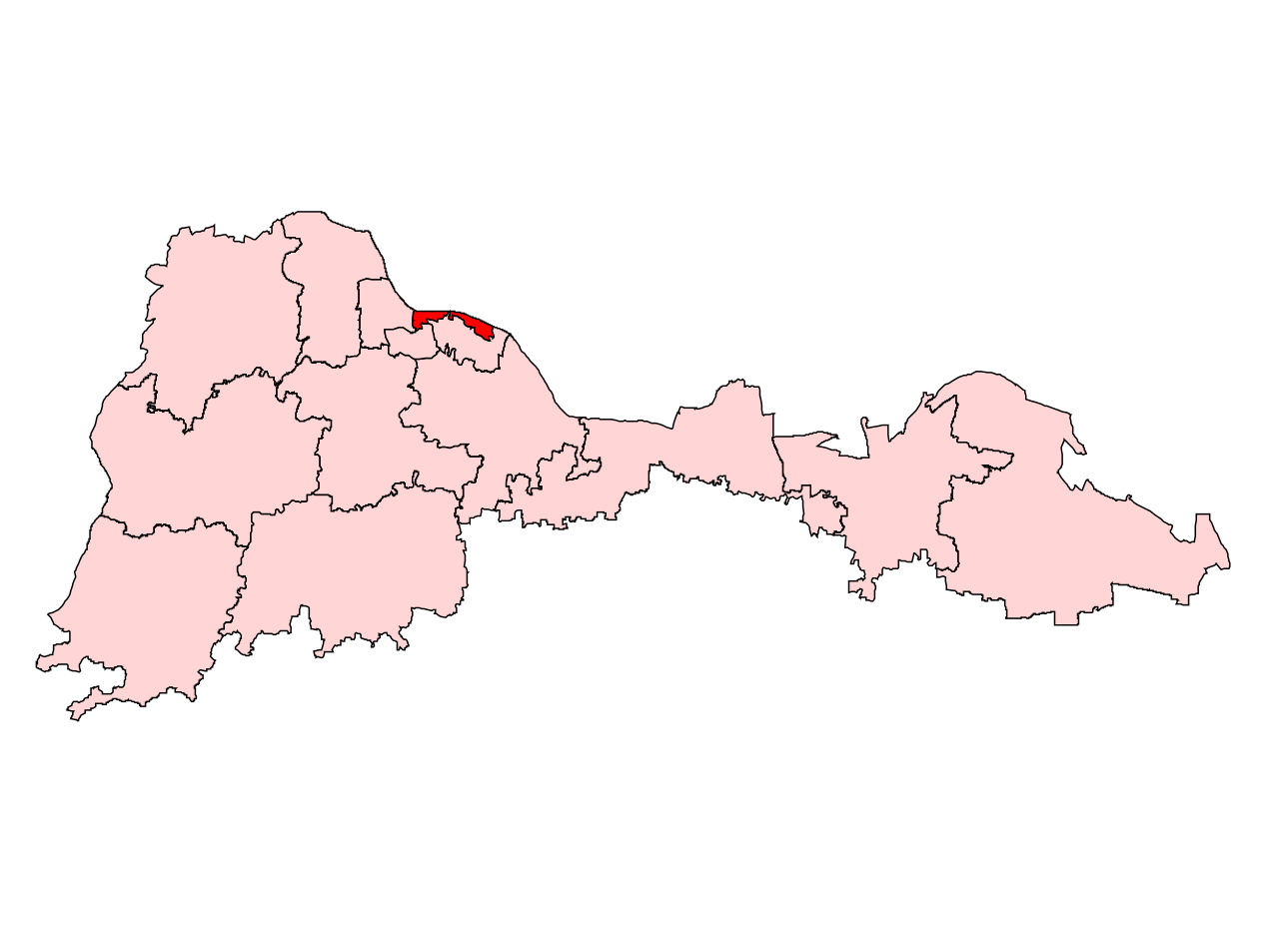
Prashant Kishor's Jan Suraaj Party ended the BJP's reported 31-year hold on the Bankipur Assembly seat in a July 2026 by-election in Patna, Bihar. Early Election Commission trends showed Kishor leading the BJP's Neeraj Kumar, with 11,603 votes after six of 31 counting rounds.
Prashant Kishor's Jan Suraaj Party has ended the BJP's 31-year hold on Bankipur, the Patna Assembly seat where the election strategist-turned-politician contested the by-election himself. Early counting trends from the Election Commission showed Kishor leading the BJP's Neeraj Kumar; after six of 31 rounds, he had 11,603 votes, or 49.96 per cent of the vote share, according to the data. Bankipur is one of Bihar's 243 Assembly constituencies and forms part of the Patna Sahib Lok Sabha seat. The constituency, a historic neighbourhood on the southern bank of the Ganges that grew into an administrative centre under British rule, is described as dominated by the Kayastha caste. The seat fell vacant after BJP national president Nitin Nabin, its long-time MLA, was elected to the Rajya Sabha in April, according to reports. The result matters beyond one seat. Kishor has called the defeat a "wake-up call" for Prime Minister Narendra Modi, according to reports, and the outcome is already prompting discussion of Jan Suraaj's prospects in Bihar's 2027 Assembly election.
Prashant Kishor leads in Bankipur as BJP's 31-year grip slips
Prashant Kishor, the election strategist who founded the Jan Suraaj Party, contested the Bankipur by-election as his party's candidate, and early trends from the Election Commission showed him leading the BJP's Neeraj Kumar. If confirmed, the result would end a reported 31-year hold on the seat by the BJP, one of the party's longest-standing urban strongholds in Bihar.
Polling in the constituency took place on a Thursday in late July 2026 and concluded peacefully, with no major incidents reported during voting. The by-election attracted outsized attention for a single assembly seat, in large part because of Kishor's decision to test his political venture at the ballot box rather than from the campaign trail, where he built his reputation advising parties across the country.
At the time these trends emerged, counting was still under way and the final result had not been declared. The Election Commission's figures were partial, covering only the early rounds of a longer counting process, and the outcome remained formally undecided. The BJP's Neeraj Kumar was trailing Kishor in those early rounds, according to the commission's data, though the gap could still shift as further rounds were tallied.
The contest also included a candidate from the Rashtriya Janata Dal, making it a three-cornered fight in the Patna seat. Jan Suraaj, founded by Kishor after his years as a consultant to national and regional parties, had not previously won a seat in the Bihar assembly.
A historic Patna seat with a long BJP pedigree
Bankipur is one of the 243 constituencies that make up the Bihar Legislative Assembly, and it forms a segment of the Patna Sahib Lok Sabha constituency. It takes its name from the Bankipur neighbourhood of central Patna, which sits on the southern bank of the Ganges.
The area carries considerable historical weight. Bankipur developed during the British colonial period as an administrative and institutional centre, and the neighbourhood remains closely associated with that era of Patna's growth. The constituency is described as dominated by the Kayastha caste, a community that has long shaped the political character of this part of the city.
The seat has also featured in the Election Commission's efforts to widen the use of voter-verifiable technology. In the 2015 Bihar Legislative Assembly election, Bankipur was among the 36 constituencies where VVPAT-enabled electronic voting machines were deployed, allowing voters to verify their choices on a paper trail.
Politically, Bankipur had been synonymous with the BJP for more than three decades. The party's hold on the seat stretched back 31 years before the by-election, making it one of the party's most durable urban bastions in Bihar and giving the contest a significance well beyond a single assembly segment in the state capital.
How the vacancy arose: Nitin Nabin's move to the Rajya Sabha
The by-election was triggered by the departure of the seat's long-serving legislator. According to reports, the vacancy arose after BJP national president Nitin Nabin was elected to the Rajya Sabha in April, leaving the Bankipur assembly seat empty and requiring a fresh poll. The precise date of his Rajya Sabha election has not been confirmed in available reporting.
Nabin's association with the constituency ran deep. Reports indicate he had won the Bankipur assembly seat for a fifth consecutive time in November of the previous year, underlining how firmly the seat had been identified with him personally before his move to the upper house of Parliament. His elevation to the Rajya Sabha, and to the BJP's national presidency, meant the party had to defend the seat without the candidate who had held it through multiple elections.
The by-election that followed, held on a Thursday in late July 2026, was therefore the first electoral test of Bankipur without Nabin on the ballot in years. Polling concluded peacefully, according to reports, setting the stage for a count that would draw attention well beyond the constituency itself.
The count so far: 11,603 votes and a near-50 per cent share
Six rounds into a 31-round count, the early numbers in Bankipur pointed clearly in one direction. Prashant Kishor, the Jan Suraaj Party candidate, had accumulated 11,603 votes, giving him 49.96 per cent of the vote share counted to that point, according to Election Commission data. That placed him ahead of the BJP's Neeraj Kumar, with early Commission trends showing Kishor in the lead.
The figures were partial. With 25 rounds of counting still to go, the final outcome, and the winning margin, remained unknown. A near-50 per cent share after six rounds was a strong position, but the count had further to run before any result could be declared.
The contest was not a two-cornered one. Alongside Kishor and the BJP candidate, the Rashtriya Janata Dal also fielded a candidate in the by-election, though the available data did not show how that contender was faring in the early rounds.
Turnout, meanwhile, was modest. The Election Commission recorded voter participation at 34.30 per cent, a figure it indicated could be revised as final data was compiled. Polling itself, held on a Thursday in late July 2026, concluded peacefully.
All the numbers cited here are provisional, drawn from the Commission's early counting data, and subject to change as the remaining rounds were tallied.
Part of a wider bypoll round that changes little on paper
Bankipur was one of several seats contested in the same round of by-elections, and the results cut both ways for the BJP. Alongside its loss in Patna, the party also fell short in Datia, while it retained the Manjalpur seat in Gujarat. Taken together, the outcomes were never expected to alter the arithmetic of power: the bypolls carried no threat to the strength of the BJP governments in the three states concerned, whatever the individual results.
That is what makes Bankipur stand apart. Its significance is symbolic rather than numerical. A seat held by the BJP for 31 years, in the heart of the state capital, slipping to a first-time electoral force is the kind of result that reverberates well beyond the assembly benches it affects. The party itself acknowledged as much. BJP leader Nitin Nabin said the party did not get the expected results in Bankipur and Datia and would introspect. For a ruling party, losing a fortress seat in a low-stakes bypoll can matter more politically than the tally suggests, because it raises questions about voter mood that no change in numbers is required to answer.
'A wake-up call': how the parties read the verdict
Prashant Kishor, the Jan Suraaj Party founder who contested the seat himself, framed the result in national terms. According to reports, he described the BJP's defeat in Bankipur as a "wake-up call" for Prime Minister Narendra Modi, casting the loss of a seat the party had held for 31 years as a message that reached beyond Patna.
Opposition parties read the verdict along similar lines, characterising it as a reflection of the public mood rather than an isolated local upset. That framing, carried in multiple reports, positioned Bankipur as evidence of discontent with the ruling alliance even in an urban seat long considered safe for the BJP.
Within the National Democratic Alliance, the tone was more restrained. NDA leaders called for introspection, and the BJP's own response came from Nitin Nabin, the senior party figure whose move to the Rajya Sabha had created the vacancy. Nabin said the party had not got the results it expected, not only in Bankipur but also in Datia, and that it would reflect on what had gone wrong. His remarks acknowledged the setback without disputing it, and stood in contrast to the sharper political meaning the opposition sought to attach to the outcome.
What Bankipur signals for Bihar's 2027 election
The implications of the Bankipur result extend well beyond one Patna seat. According to reports, the verdict has already prompted discussion about the Jan Suraaj Party's prospects in Bihar's 2027 Assembly election — a contest in which Prashant Kishor's young outfit hopes to convert a symbolic bypoll breakthrough into a serious statewide challenge. For the BJP, the loss of a seat it held for 31 years raises uncomfortable questions about its grip on a state it has long dominated, even if a single by-election changes nothing in the assembly arithmetic.
Much remains unclear. The final margin of victory is not yet confirmed, with counting trends showing only partial results. The Election Commission has indicated the reported turnout of 34.30 per cent could be revised. And the performance of the RJD candidate — the third force in the contest — is not yet known. How each party reads those final numbers will shape the narrative heading into 2027.
Frequently asked questions
Who won the Bankipur by-election?
Prashant Kishor, founder of the Jan Suraaj Party, contested the Bankipur by-election as his party's candidate. Early Election Commission trends showed him leading the BJP's Neeraj Kumar, and after six of 31 counting rounds he had 11,603 votes, or 49.96 per cent of the vote share, according to Election Commission data. The final result and margin had not been confirmed at the time of reporting.
Why was a by-election held in Bankipur?
The by-election was held because the seat fell vacant after BJP national president Nitin Nabin was elected to the Rajya Sabha in April, according to reports. Nabin had won the Bankipur assembly seat for a fifth consecutive time in November of the previous year. Polling took place on a Thursday in late July 2026 and concluded peacefully.
Where is the Bankipur Assembly constituency?
Bankipur is one of the 243 constituencies of the Bihar Legislative Assembly and a segment of the Patna Sahib Lok Sabha constituency. It covers a historic neighbourhood in central Patna on the southern bank of the Ganges, which developed during the British colonial period as an administrative and institutional centre. The constituency is described as dominated by the Kayastha caste.
Why is the Bankipur by-election result significant?
The result ended a reported 31-year BJP hold on the seat. BJP leader Nitin Nabin said the party did not get the expected results in Bankipur and Datia and would introspect. Prashant Kishor described the BJP's defeat as a 'wake-up call' for Prime Minister Narendra Modi, according to reports. The outcome has also prompted discussion about Jan Suraaj's prospects in Bihar's 2027 Assembly election.
What was the voter turnout in the Bankipur by-election?
Voter turnout was recorded at 34.30 per cent, according to reports, though the Election Commission indicated the figure could be revised. Polling took place on a Thursday in late July 2026 and concluded peacefully. The bypolls, which also covered seats including Manjalpur in Gujarat and Datia, were not expected to change the strength of the BJP governments in the three states concerned.
Compiled from reporting by 10 independent outlets. How we source our reporting.


